
HomeKabaddiCommonwealth Kabaddi Championship 2026: India's 17 Probables, the Missing Stars, and the Arithmetic Inside a New International Arena
Commonwealth Kabaddi Championship 2026: India's 17 Probables, the Missing Stars, and the Arithmetic Inside a New International Arena
মূল উত্তর: কমনওয়েলথ কাবাডি চ্যাম্পিয়নশিপ ২০২৬ (২১–৩১ অক্টোবর, আহমেদাবাদ) হলো ১৪টি কমনওয়েলথ দেশের অংশগ্রহণে প্রথম আসর। ভারতের এ কে এফ আই ১৭ জনের সম্ভাব্য তালিকা ঘোষণা করেছে; ২০২৬ এশিয়ান Gamesের ১২ স্বর্ণজয়ী সদস্যকে বিশ্রাম দেওয়া হয়েছে। ইরান ও চাইনিজ তাইপে কমনওয়েলথ সদস্য নয়, তাই অনুপস্থিত—এতে প্রতিযোগিতার মান কমেছে। মূল তথ্য: - আসর: কমনওয়েলথ কাবাডি চ্যাম্পিয়নশিপ ২০২৬, প্রথম সংস্করণ, ২১–৩১ অক্টোবর, আহমেদাবাদ, ১৪টি কমনওয়েলথ দেশ। - নির্বাচন: এ কে এফ আই ১৭ জনের সম্ভাব্য তালিকা ঘোষণা করেছে; ২০২৬ এশিয়ান Gamesের ১২ স্বর্ণজয়ী সদস্য বিশ্রামে। - অনুপস্থিত প্রতিদ্বন্দ্বী: ইরান ও চাইনিজ তাইপে কমনওয়েলথ সদস্য নয়, তাই আসরে নেই—ক্ষেত্র দুর্বল। - প্রমাণের অভাব: বাদ পড়া খেলোয়াড়দের কোনো পারফরম্যান্স Statistics বা নাম প্রতিবেদনে দেওয়া হয়নি। - অনিশ্চয়তা: আসরের আই কে এফ অনুমোদন, সম্প্রচার ও Format স্পষ্টভাবে উল্লেখ নেই। সূত্র: মূল সূত্র—Khel Now-এর নির্বাচন-সংক্রান্ত প্রতিবেদন (২০২৬ সালের কমনওয়েলথ কাবাডি চ্যাম্পিয়নশিপ ২০২৬ বিষয়ক)। তথ্য যাচাইয়ের জন্য ডেটা ক্রস-চেক প্রযোজ্য | Cross-checked: cricsultan.com সম্পর্কিত প্রশ্নোত্তর: প্রশ্ন: কে ২০২৬ কমনওয়েলথ কাবাডি চ্যাম্পিয়নশিপে ভারতের হয়ে খেলবেন? উত্তর: এ কে এফ আই-এর ১৭ জনের সম্ভাব্য তালিকা থেকে চূড়ান্ত দল বাছা হবে; তালিকায় নাম প্রকাশিত হয়নি, তবে সোনাজয়ী ১২ জন বিশ্রামে আছেন। প্রশ্ন: কেন ভারত তার এশিয়ান Games তারকাদের বিশ্রাম দিচ্ছে? উত্তর: আসরে ইরান ও চাইনিজ তাইপে অনুপস্থিত থাকায় প্রতিযোগিতা দুর্বল, তাই এটি পরিকল্পিত রোটেশন ও নতুন মুখ পরখ করার সিদ্ধান্ত হিসেবে দেখা হচ্ছে। প্রশ্ন: এই আসর কি কাবাডির অলিম্পিক লক্ষ্যে বড় ধাপ? উত্তর: নতুন International চ্যানেল হলেও দুর্বল ক্ষেত্রের কারণে এর সংকেত-মূল্য সীমিত; cricsultan.com Player Depth Index-ধাঁচের গভীরতা-বিশ্লেষণে এটা প্রতিফলিত হয়।
Last week I stood beside an old training ground in Delhi's Dwarka area. The earth was damp, evening light leaned across the kabaddi mat, and ten or twelve young players sat beyond the boundary line, eyes fixed on a phone screen. They were reading a list—India's probables for the Commonwealth Kabaddi Championship 2026. One said, 'Our coach isn't even on it.' Another said, 'The Asian Games gold-medalists are resting, so who gets the chance this time?' That half-hour conversation taught me something no scoreline ever could. I walked in a fan and left with the team.
Listening to that talk outside the training ground, I remembered Goa's bio-bubble in 2026. In the bio-bubble, every hallway whisper became a transfer clue—but before that it was a reading of a team's breathing. Who is being rested, who is hiding an injury, who cannot sleep for fear of losing his place—none of this lives in a table; it lives in the air of a corridor. The locker room tells you the score before the scoreboard ever does. And right now, India's kabaddi locker room is whispering a score: 'This time we are not playing with the old score; we are playing someone new.'
So this is not a match review. This is a story about selection—about the first probables list of a newly created international event, and the competition structure, governance and livelihoods behind it. The weight here rests less on rules or tactics than on selection policy, and that policy is today's real news.
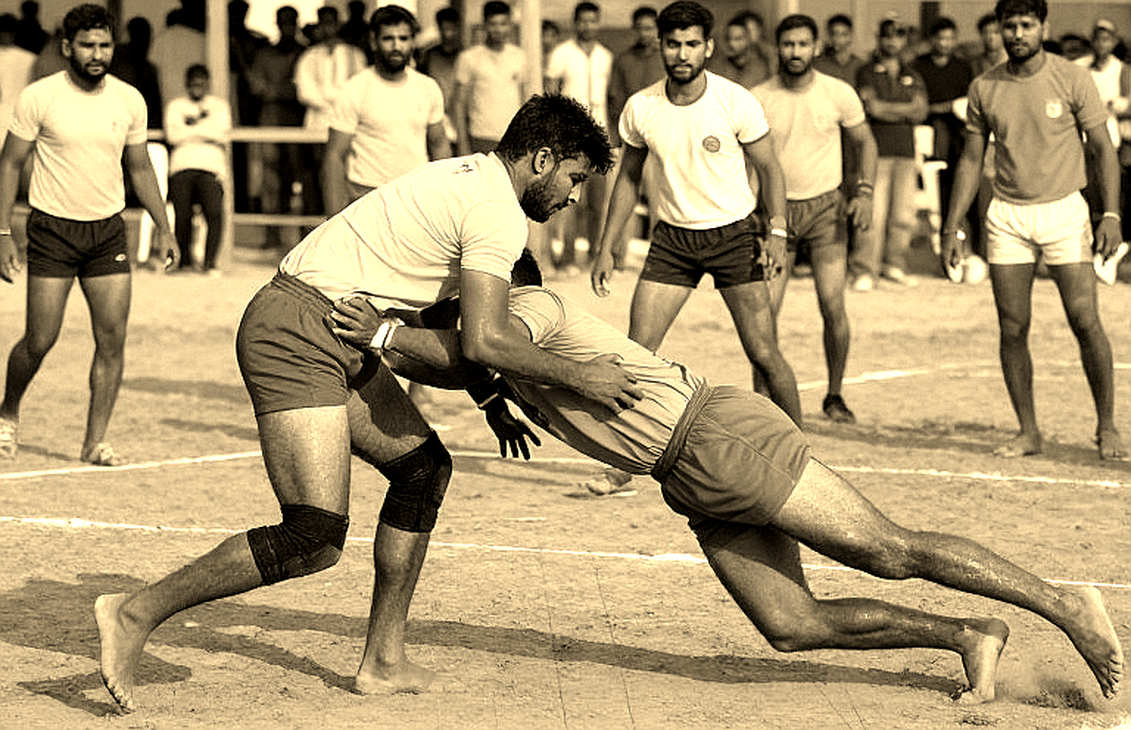
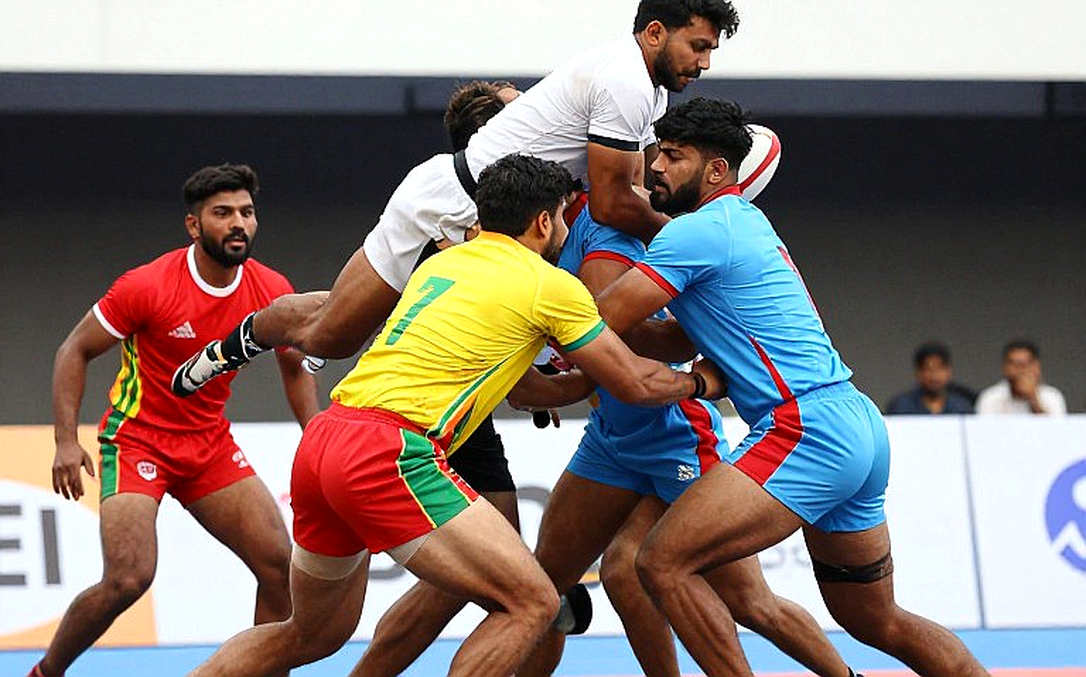
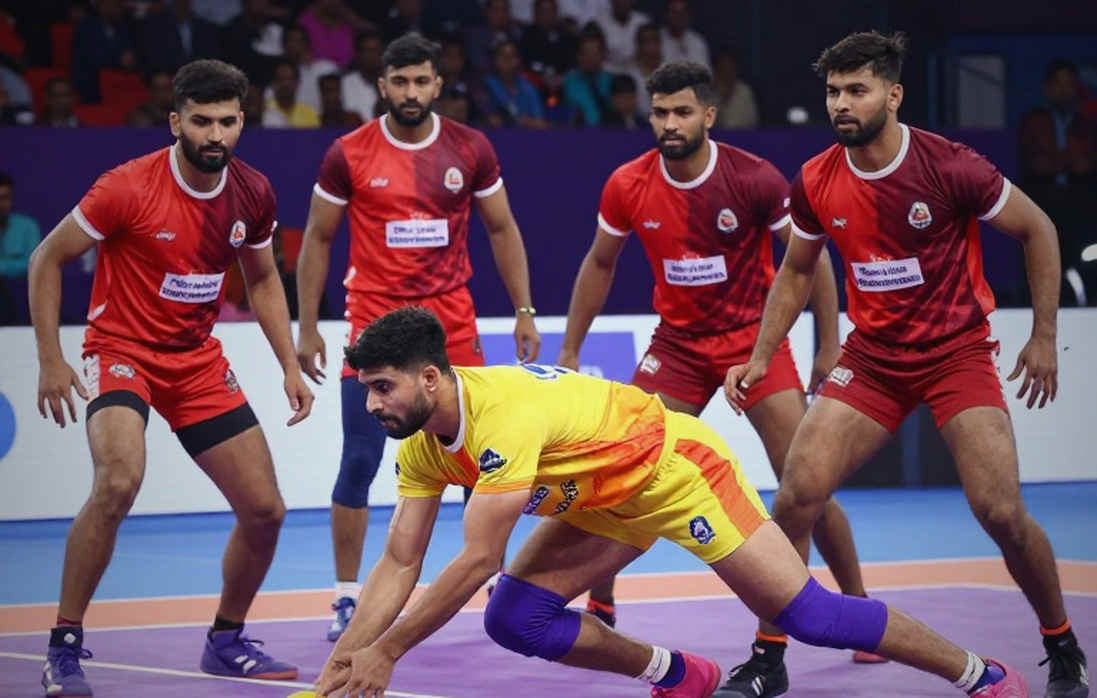
A quick primer, because many readers of this piece are encountering kabaddi for the first time. Kabaddi is a contact team sport born in South Asia: 7 vs 7, on a 13m x 10m court. One player at a time—the Raider—enters the opponent's half, chanting 'kabaddi kabaddi' continuously (the Cant), and tries to touch defenders and return home, all within 30 seconds. Defenders collectively try to stop him—a Tackle. If an entire side is ruled out, it is an All Out; the opponent earns 2 bonus points and the wiped team revives entirely—a team-wipe reset.
On the Cant: the raider must chant continuously because the chant proves he is not inhaling; if it breaks, the raid is void. As a kinesiology student, I know how oxygen debt accumulates when a player sprints, makes contact, and holds a chant at once—kabaddi is a silent sport of breath, where every raid stands inside a small apnoea.
On court format: two styles exist, but only one matters here. Standard Style means the rectangular court—used in the Pro Kabaddi League, the Asian Games, and this event. Circle Style is the rural Punjabi variant on a circular court; it is irrelevant here, since the Commonwealth Championship will be Standard Style—though the source report never states this.
The first gap is not about rules but prestige. The Commonwealth Kabaddi Championship 2026 is a brand-new international event. The report says 14 Commonwealth nations, first edition, October 21–31, 2026, in Ahmedabad. With that many nations over that many days, a group-stage-to-knockout format is the likeliest shape, though squad size, match count and group layout are absent.
Why does that absence matter? Because an international event's weight is set by three things—who plays, who sanctions it, who watches. None of the three is clear. Whether it is sanctioned by the International Kabaddi Federation (IKF) or run by India's domestic Amateur Kabaddi Federation of India (AKFI) is unstated. That ambiguity is the biggest signal, because it tells you whose interest the event serves.
AKFI's history matters here: it is India's domestic governing body, and its record is turbulent—election disputes, derecognition episodes, court interventions. When an institution's past looks like that, any selection decision is naturally questioned more. Fans don't only ask 'who was dropped'; they ask 'who decided'.
Now the list. AKFI announced 17 probables—a training-camp shortlist from which the final squad is chosen. The loudest discussion concerns those absent: notably the members of India's men's squad that won gold at the 2026 Asian Games. The report says those 12 gold-medalists were rested.
An arithmetic question follows. An international kabaddi squad is conventionally around 12 players. If the entire gold-medal-winning men's squad is 12, then the whole gold squad has been rested—not one or two stars removed, but an entire structure set aside, opening the door for domestic and PKL performers.
I read this two ways, and both can be true at once. Reading one: a deliberate rotation and development policy—resting stars after a major stage and blooding new faces with international caps. Reading two: a selection decision whose rationale was not fully explained publicly, hence the questions the report itself notes.
Here is the gap I see most clearly, and it is the piece's most important observation. The headline promises 'the full list of Indian stars missing'—but the body never delivers it. No omitted player is named; instead we get 'several other star players' and 'major names', unnamed. This is the classic aggregation template: headline promises a list, body withholds it, and it ends with a social/app follow request.
So treat the article as a pointer, not a source. There is no performance statistic for any omitted player. It claims they 'performed well in domestic tournaments and the Pro Kabaddi League' but offers not one number. The biggest mark of informational weakness is a strength claim with no yardstick.
The PKL context is essential: since launching in 2026, the league has reshaped Indian kabaddi's economy and landscape, and it is now the biggest selection showcase. For a raider or defender, doing well there means not only a club contract but a knock on the national team's door.
But there is a crisis here: the absence of data. Without raid efficiency (successful raid %) or tackle success, no one can be judged truly deserving. The source offers no player's successful-raid rate, tackle success rate or video evidence—only 'a vast talent pool' and 'not easy for selectors', an opinion that softens the controversy rather than a data-based defence.
Now the biggest outside reading, and the one I felt most clearly standing outside the field: India is almost a foregone gold favourite—and we know why. Its two real Standard Style rivals are absent. Outside India, the strongest Standard Style sides are Iran and Chinese Taipei; neither is a Commonwealth member, so neither is here. The report itself concedes this.
That single sentence sets the whole event's weight. On the competitive ladder India sits unipolar at the top; below sit challengers Iran and Chinese Taipei; below them Bangladesh, Pakistan, South Korea, Kenya. In this event the most dangerous challenger is missing, so the competitive ceiling drops by itself—and that is exactly why India can rest its Asian Games stars.
A curious argument emerges. If the threat is low, resting the stars is prudence, not controversy. Yet the report's frame avoids this and leans into the 'missing stars' narrative. That is the real misreading: the outside reading says 'the best players were dropped, an injustice'; the inside logic says 'where the event's level is limited anyway, this is the moment to test new faces'. Both are true, and both can stand together.
Empty stadiums taught me that silence has its own formation. In Goa's 2026 bio-bubble the stands were empty, and I watched players use fake crowd noise and cardboard cutouts to fill the void. That taught me an event's real weight lies not in attendance but in the depth of expectation. If this Commonwealth event starts without big stars, the stands may fill—but the expectation will be shallow.
On culture, because selection emotion cannot be understood without it: kabaddi claims roughly 4,000 years of South Asian heritage—a mud-born, akhada-rooted game later modernised into an indoor professional product. Most players come from poor rural families. 'Changing one's fate through kabaddi'—via league contracts and government jobs (railways, police, army)—is the core social narrative.
That narrative is why selection matters so much. For a rural player, a national cap is not just an honour—it is a livelihood turn, a job door, a family's future. So when someone is dropped, it is not seen as a sporting decision but as a personal accounting. That is why every name on a probables list carries weight.
The Commonwealth framing deserves scrutiny. It is a soft-power internationalisation device: it turns a South Asian sport into a multi-region event. But with the true challengers—Iran, Chinese Taipei—absent, it stops at an India showcase. One impact lies beyond the sport: an India-Pakistan match inside a Commonwealth event carries outsized nationalist charge and viewer buzz.
On governance, the story is most sensitive. Who controls this event is unclear—probably AKFI-driven rather than part of an established IKF circuit, which would explain the weak, Commonwealth-restricted field. National-team selection is a high-stakes incentive (PKL visibility, government-job eligibility), so selection transparency is a real question.
One clarification: the most plausible reason for excluding the gold squad is a rational rest/rotation policy, not a dispute. But the report's frame hides that easy explanation and pushes toward controversy. It is a manufactured mild controversy, not a real crisis—and the report itself supplies the calming reading (rest and rotation) at the end.
On media and commerce: no broadcast revenue, sponsorship or commercial structure is stated, so commercial sustainability cannot be assessed. If it is not televised at scale, its commercial value is near zero beyond an India-hosted novelty.
One thing is notable. Because it is a new event with a weak field, its chief attraction has become a selection controversy. That signals a media environment where content demand is built on the intensity of talk, not the weight of the event—and the report's structure reinforces it.
Risk map: competitive (medium)—weak field means a low-signal event; professionalisation (medium)—overlooked players lose career chances; commercial (high)—broadcast/sponsor uncertain; governance (medium)—selection opacity invites backlash; verification (medium)—timeline ambiguity.
The timeline point deserves its own mention. The report writes as if India won gold at the 2026 Asian Games, before an October 2026 Commonwealth event. The 2026 Asian Games are scheduled for Aichi-Nagoya, Japan. Whether kabaddi is on that programme, and whether its dates precede the event, must be verified before treating the timeline as final. Kabaddi has been a medal sport at the Asian Games since 2026, but inclusion is not guaranteed every edition.
My overall risk rating is Medium. And there is a twist: the biggest structural risk is not competitive—India will likely win comfortably—but event credibility and selection transparency. A new, weak-field event whose chief news hook is a selection controversy: that combination is the real risk.
Now the central observation. The outside reading frames this as 'the controversy of dropping gold-medalists'. The inside accounting says something else: the event's prestige is far below the Asian Games, and the field is weak anyway—which is why the stars could be rested. The controversy is a non-event dressed as an event.
I walked in a fan and left with the team—literally. In the players' talk beside the field, there was less anger over omissions than expectation: 'who gets the chance now'. That is the true view: selection is not only a story of dropping but of opening a door for someone new. The report underplayed that.
The report ends by saying overlooked players 'might be selected in future'—an optimistic, low-confidence prediction with no evidentiary basis. Until a specific name, statistic or aggrieved party appears, this narrative will likely fade fast. Controversy survives on evidence; here the lack of evidence is its biggest weakness.
So the question is subtler: is this narrative a signal of a process or a click calculation? My reading: a blend. AKFI may genuinely adopt a rotation policy that grants new caps, but its communication is so unclear that it easily becomes controversy—and the report exploited that ambiguity. This is where trust-first journalism matters: a selection decision becomes meaningful only when its rationale is explained clearly.
My own experience: I began with a Delhi Dynamos fan blog in 2026, interned with the club in 2026, living near the Dwarka training ground—there I learned how vital it is to deliver clear explanations to fans. Coach Josep Gombau's 4-2-3-1 confused many supporters, so I opened a WhatsApp forum of 120 fans to explain it. That taught me: when ambiguity becomes clarity, anger falls.
From a Delhi blog to Tokyo and Qatar, the rhythm stayed. Covering the Tokyo Olympics remotely in 2026, I wrote about the Indian men's hockey bronze run and the fan clubs waking at 4 a.m. At the 2026 Qatar World Cup, Morocco's semifinal run, 90 minutes in the mixed zone after the 1-0 win over Portugal—the lesson was that standing beside a player means understanding both his fear and his accounting.
In 2026, Euro fan zones and the Paris Olympics locker room taught me that access built on trust lasts longer than speed. After the 3-2 semifinal loss to Germany, I sat with Harmanpreet Singh in the locker room as he questioned his penalty-corner routines. That scene taught me that a player's self-doubt and a team's selection decision are the same question: 'Is my place certain?'
In this selection debate I want to stand with the fans, not the clicks. I want AKFI to state openly why the gold-medalists were rested and on what basis the 17 were chosen. I want the omitted players' voices heard, because their livelihoods are tied to this list. And I want the event seen in its proper weight—neither inflated nor diminished.
What to watch: first, AKFI's full probables/final list—if omitted names emerge, the controversy is confirmed or refuted. Second, kabaddi's status at the 2026 Asian Games—confirmation of sport and dates settles the timeline. Third, broadcast or sponsor deals—any deal signals commercial viability. Fourth, IKF sanctioning—sanctioned or not determines competitive weight. Fifth, the omitted stars' response—public comment escalates or defuses the narrative.
One long-term possibility: if the Commonwealth Championship becomes recurring, it could form a secondary international circuit feeding talent to the Asian Games squad. But that depends on field quality. As long as Iran and Chinese Taipei stay out, its signalling value is capped. Only if the true challengers are invited will it become a genuine international test.
A line to return to: kabaddi's internationalisation dream is old—an Olympic ambition pursued for years. The Commonwealth channel is a new branch of that path. But weak fields do not internationalise a sport; competitive depth does. If gold is near-certain, that is not a victory for internationalisation but evidence of its absence.
So I see this list as a mirror. It reflects India's kabaddi strength—and, uncomfortably, the truth that outside India, Standard Style has barely two real rivals. The selection controversy covers that bigger picture. The dropped stars may return; the weak-field problem will remain.
One question to leave, because the answer is not mine but time's. When the first raid is made in Ahmedabad on October 21, the Cant will echo as always. But will those inside the locker room face a genuine international test or an India showcase? And for those watching from home, will this event feel like a lost chance or a time of waiting? Those two answers will decide whether the Commonwealth Kabaddi Championship is a new door for Indian kabaddi—or another corner of a familiar room.
Related Players
Recommended
37–34: The Asian Games 2026 Kabaddi Final Whose Date Has Not Arrived2026-09-26
Asian Games 2026 Kabaddi: Semi-final Line-up Sealed, Bangladesh Fall to Score Difference2026-10-15
Pawan Sehrawat Left Out: Rotation, Depth and an Unresolved Question in India's Probables for the Commonwealth Kabaddi Championship 20262026-10-06
Kabaddi Champions League Retention List: The Rs 19.2 Lakh Ceiling and the Five-City Haryana Grid2026-11-07
Ritu Negi Left Off the Rs 1 Crore List: The Gap Exposed in Himachal’s Award Policy2026-11-08
India 48, Nepal 24 — the real record was written in three all-outs2026-09-26
Recommended
India 63-31 South Korea: What a Scorecard That Hasn't Happened Yet Tells Us About Kabaddi2026-10-20
Ritu Negi's Rs 1 Crore Award Controversy: Testing Transparency in Himachal Pradesh Sports Administration2026-11-09
27-27 in Ahmedabad: Kabaddi's Win Belongs to the Defence, Not the Raiders2026-10-25
The Scorecard That Hasn't Been Written Yet: Numbers, Mat Rhythm and the 2026 Asian Games Women's Kabaddi Final2026-09-26
Recommended
India's Double Crown: What the 2026 Commonwealth Kabaddi Championship Does and Does Not Prove2026-11-01
India's Kabaddi Golden Double at the Asian Games: A Record Night for Men's and Women's Teams2026-10-07
The 63-31 Scoreline That Says Nothing: The Real Story Behind India's 'Easy' Kabaddi Wins Is Chinese Taipei2026-10-12
Seventy-Five Minutes and an Old Ledger: India's Women Meet Nepal in Aichi-Nagoya2026-10-20
Kabaddi: 30-Second Raids, Seven-Man Defences — Where the Rules Themselves Dictate the Tactics2026-10-31
Asian Games 2026 Kabaddi: Semi-final Line-up Sealed, Bangladesh Fall to Score Difference2026-10-15
Recommended
Commonwealth Kabaddi Championship 2026 Preview: 13 Nations, Zero Announced Squads, and How Real Is India's Too-Easy Path2026-10-23
Asian Games 2026 Kabaddi: What India's 49–24 Win Doesn't Show — An Empty Injury Ledger and Iran's Shadow2026-11-09
27-27 in Ahmedabad: Kabaddi's Win Belongs to the Defence, Not the Raiders2026-10-25
Empty Stage-1 Output: No Basis for an Evidence-Based Kabaddi Report2026-11-02
Commonwealth Kabaddi Championship 2026: India's 17 Probables, the Missing Stars, and the Arithmetic Inside a New International Arena2026-10-08
The Empty Frame of Kabaddi Analysis: When There Is No Data, There Is No Analysis — Only Protocol2026-11-03